
Active Heave Compensation: How It Works & How to Implement It
Not sure if your winch is suitable for AHC?
What is Active Heave Compensation?
Active heave compensation (AHC) is a control technology that measures vessel motion in real time and uses that data to drive a winch or cylinder in the opposing direction, keeping subsea loads stable regardless of wave conditions. The result is a longer operational weather window, reduced equipment wear, and safer offshore operations.
This guide covers how AHC works, how it compares to passive systems, which operations benefit most, and what to look for in an AHC controller.
How Active Heave Compensation Works
The Active Heave Compensation (AHC) system works by sensing the heave motion and then applying an opposing motion. This process is known as active heave compensation. When vessel motion is detected, the sensors send a signal to the controller. The AHC controller then calculates the necessary control signal for the winch/cylinder. The AHC system continuously monitors the heave motion and adjusts the control signals applied to compensate for the changing motion. This allows the vessel to maintain a stable underwater operation, even in rough seas.
Passive heave compensation (PHC) is a technique used to reduce the effects of vessel motion by using the natural damping characteristics of the system to reduce the amplitude of the heave motion. This is typically achieved through the use of hydraulic cylinders or tension control on winches. Passive heave compensation systems are simple and reliable, but they are not as effective at reducing heave as active heave compensation systems.
In contrast, active heave compensation measures the vessel motion using a motion reference unit (MRU) and uses this information to control a winch or a cylinder. Active heave compensation systems used to be more complex and require more maintenance than passive systems, until the new AHC Controller entered the market.
The practical difference: a passive system reduces motion amplitude by 40-60% through mechanical damping. An active system using a dedicated controller and MRU typically achieves 90-98% motion reduction, making operations viable in sea states where passive systems fall short.
Active Heave Compensation VS Passive Heave Compensation
| Aspect | Passive Heave Compensation (PHC) | Active Heave Compensation (AHC) |
|---|---|---|
| Mechanism | Mechanical damping via hydraulic cylinders or tension control | Real-time motion sensing (MRU) driving a winch or cylinder in the opposing direction |
| Motion reduction | 40-60% | 90-98% |
| Load size dependency | Most effective with large loads or a fixed structure connection | Effective independent of load size or shape |
| Control input | None (mechanical response only) | Motion reference unit (MRU) + dedicated controller |
| Historical complexity | Simple, low maintenance | Significantly reduced by standardized AHC controllers |
Advantages of Active Heave Compensation
The primary benefit of Active Heave Compensation (AHC) is the ability to reduce the effects of vessel motion on equipment used for subsea operations. By actively compensating for the vessel motion, caused by waves, winds, and other external factors, equipment for underwater operations can remain stable and safe in rough seas. This is particularly important for vessels with subsea equipment that need to maintain a certain level of stability in order to safely operate in rough conditions.
In addition to providing stability, Active Heave Compensation (AHC) systems can also improve the efficiency of subsea operations. By reducing the effects of vessel motion, operations can be conducted more quickly, precisely, and safely. This can be especially beneficial for tasks that require precise movements, such as laying pipe and drilling operations.

Examples of applications that benefit from AHC:

ROV Operations
Extend the weather window for your ROV operations with an AHC system that stabilises the TMS and enables safe docking even in bad weather. Scantrol AHC can be retrofitted to a wide range of existing LARS systems. Learn more
Offshore Cranes

It is widely accepted that AHC provides an increase in performance for large offshore cranes. Scantrol AHC technology makes it affordable to utilize this advantage even on smaller cranes. Learn more

Intervention
Scantrol AHC combines winch and cylinder control to ensure safe and effective intervention operations.
Boulder Clearance

Active Heave Compensation ensures smooth lifting and precise control of grabs and salvage equipment, reducing strain on systems and increasing uptime during offshore operations. Learn more

Drilling
Scantrol AHC will add accuracy to your passive compensation system and secure optimum bit weight and displacement control when drilling in varying structures. Learn more
Collecting Scientific Data

Most data sampling equipment is affected by vessel motion. Read more about how our AHC solutions can improve performance in all weather conditions. Learn more
Towing Operations

Whether you are towing a sonar or other survey equipment, Scantrol AHC will keep it stable at a certain depth or follow the seabed profile. Learn more
mTrack AHC Case Studies
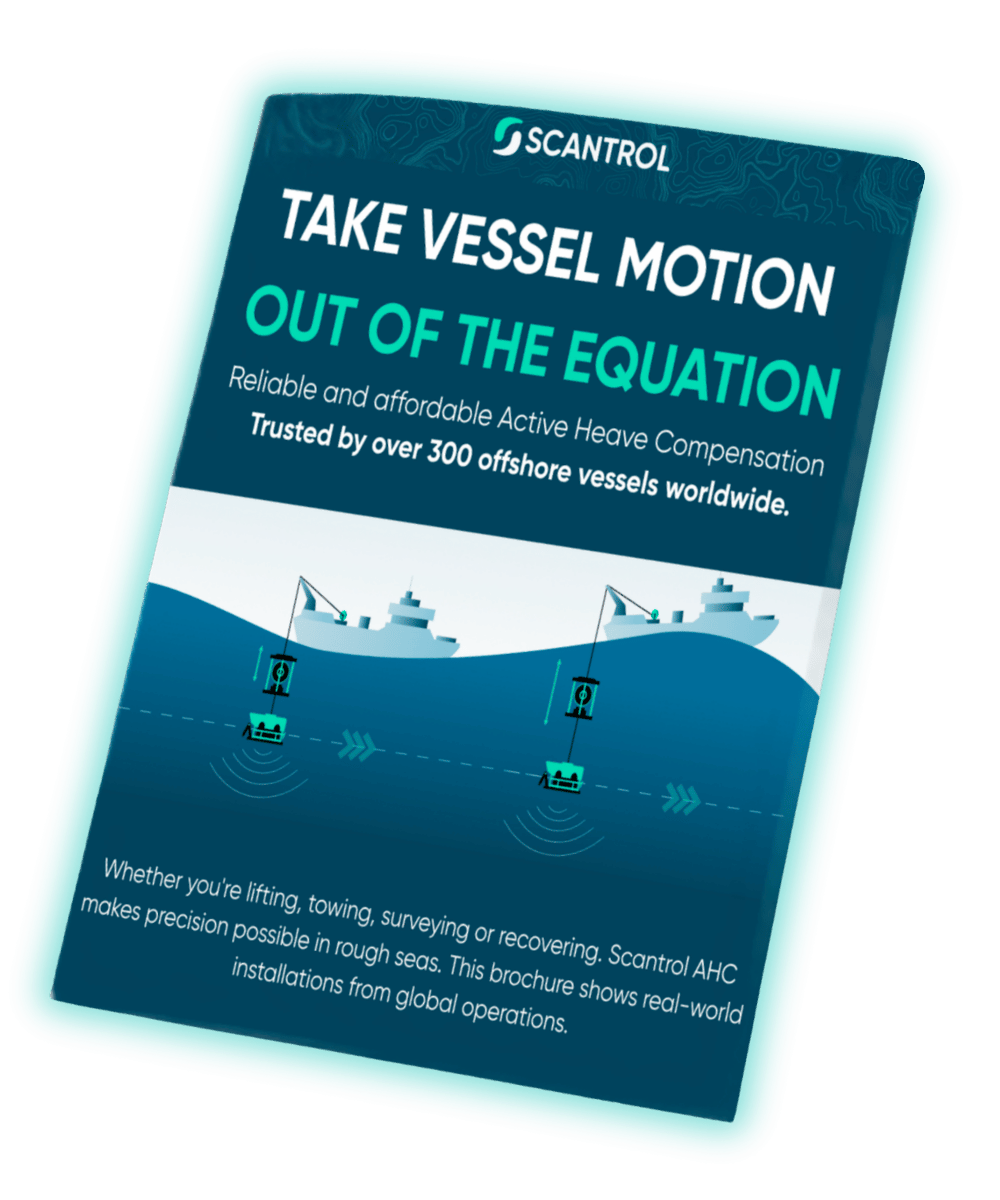
What Happens When Vessel Motion Is No Longer the Limiting Factor
Explore case studies from operators using mTrack AHC in rough sea states, deep water and time-critical operations. Each one shows the specific application, the integration approach and the outcome reported by the operator.
What to Look for in an AHC System
Not all AHC systems require months of engineering work or expensive sea trials. The key specifications to evaluate are:
- Integrated MRU: eliminates the need for a separate motion reference unit and external calibration
- Pre-configured apps: ready-made setups for winches, cranes, LARS, and cylinders reduce commissioning time
- Autotune capability: lets you test and tune at dockside rather than offshore
- Profinet and Modbus support: ensures compatibility with standard PLC environments without custom programming
- Retrofit compatibility: allows integration with existing winches, avoiding full system replacement
The mTrack AHC Controller is designed around all five criteria. It ships pre-calibrated, includes Dynatest simulation tools, and has been installed on 220+ systems globally across ROV operations, offshore cranes, LARS, and research vessels.
mTrack is available as a standalone integrated solution for existing control systems, or as a complete pre-configured control cabinet. See integration options →
Vessel Operator / End User:
→ Download mTrack AHC Case Studies Brochure
The Components of an Active Heave Compensation System
mTrack AHC Controller with integrated motion reference unit is a key component for a safe and efficient active heave compensation system and Includes all the tools you need for easy installation and commissioning. Click here to read more about mTrack AHC Controller
mTrack AHC Controller
Off-the-shelf AHC controller with integrated MRU - no separate sensor required
Pre-defined apps for winch, crane, LARS, and cylinder - no custom programming needed
Auto Calibration and Dynatest included - commission at dockside, no sea trials
Includes all the tools you need for easy installation - no need for expensive experts
Cost effective and easy-to-integrate AHC solution

Add Value to your New Winch with Scantrol AHC
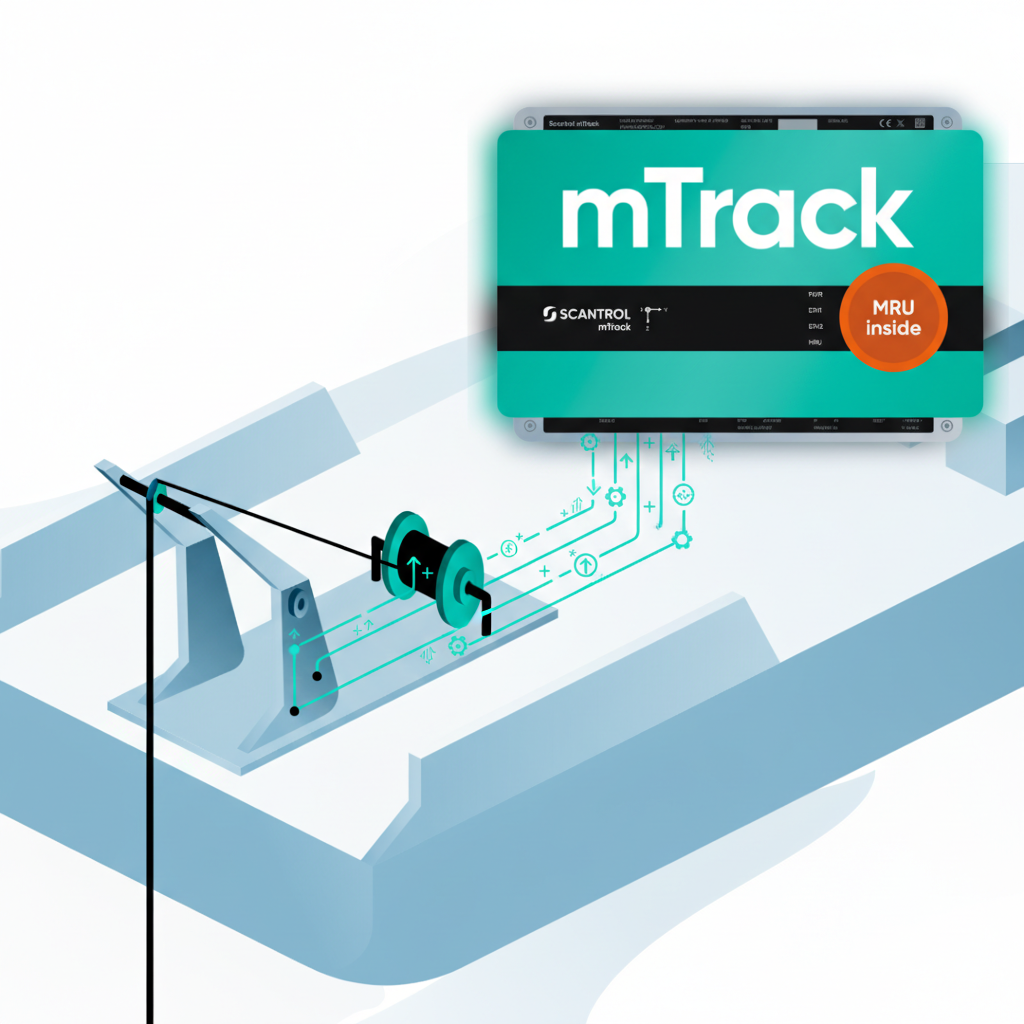
The easiest way to add AHC is by connecting the mTrack controller to your own winch control system. If you need a complete control package, Scantrol can deliver that as well.
We offer free design support for active heave compensation systems, including:
• Guiding on AHC requirements for specific applications
• Advice on selection of hydraulic winches or electric drives and components
• AHC Analyzer for calculation of AHC performance and required power, speed, and torque
Frequently Asked Questions
-
Active heave compensation (AHC) is a control technology that measures vessel motion in real time using a motion reference unit (MRU) and drives a winch or cylinder in the opposing direction to keep a subsea load stable. It is used on cranes, winches, LARS, and cylinder systems in offshore and subsea operations.
-
Heave compensation is the general term for any system, active or passive, that reduces the effect of a vessel's vertical wave-induced motion on a suspended load or piece of equipment. Passive systems use mechanical damping; active systems use real-time sensors and a controller. AHC is the active category of heave compensation.tion
-
A motion compensator uses a motion reference unit to measure a vessel's vertical movement, then sends that data to a controller. The controller calculates the required counter-motion and drives a winch or cylinder to move the load in the opposite direction, keeping it stationary relative to the seabed or a fixed point.
-
Heave is one of a vessel's six degrees of motion: the vertical up-and-down movement caused by waves. It differs from pitch (bow-to-stern rotation) and roll (side-to-side rotation). Heave is the motion that active heave compensation systems are specifically designed to counteract.
-
Passive heave compensation reduces vessel motion by 40-60% through mechanical damping, typically hydraulic cylinders or spring systems. Active heave compensation uses a motion reference unit to measure vessel movement in real time and drives a winch or cylinder in the opposing direction, achieving 90-98% motion reduction.
-
A complete AHC system requires a motion reference unit (MRU) to measure vessel heave, a controller to process the signal and calculate the compensation response, and a winch or hydraulic cylinder to execute that response. The mTrack AHC Controller integrates the MRU directly into the unit.
-
Yes. Many standard winches are suitable for AHC operation. mTrack connects to your existing winch control system without custom PLC programming. Scantrol offers a free AHC analysis to determine whether your winch is suitable for retrofit.
-
ROV launch and recovery, offshore crane operations, subsea intervention, LARS systems, scientific data collection, drilling and coring, and towing of sonar or survey equipment. AHC is particularly critical in operations where load stability directly affects safety, data quality, or equipment integrity.
Have questions or would you like to discuss your project?
If you have any questions about AHC, your application, or next steps, you are welcome to reach out directly.

Suzy Zhu
International Sales Manager
Email: suzy@scantrol.com
Phone: +47 465 20 370
Jan Kjærstad
CEO
Email: jan.kjarstad@scantrol.com
Phone: +47 911 59 434

Henry Boddington,
International Sales Manager
Email: henry@scantrol.com
Phone: +47 901 57 044
We are happy to review your setup, answer technical questions, or schedule a meeting