
Active Heave Compensation for Scientific Research Equipment
Every degree of vessel roll and heave transfers directly into towed and lowered scientific equipment, narrowing your usable weather window and putting data quality at risk.

Active heave compensation (AHC) for scientific and research equipment keeps CTD/Rosette casts, core and grab samples, and towed sensors stable relative to the seabed or a fixed depth, removing vessel motion from the equation regardless of the equipment's weight or shape. mTrack, Scantrol's AHC controller with integrated motion reference unit (MRU), adds this stabilization to an existing research winch without replacing the mechanical hardware, correcting light, streamlined gear that constant tension has little grip on once the weather turns.
For research vessel operators, this means CTD casts and core samples come up undamaged, towed cameras and sensors hold a constant distance to the seabed via Follow Seabed, and survey operations can continue in sea states that would otherwise force a delay or compromise the data.
mTrack AHC Controller
Off-the-shelf AHC controller with integrated MRU - no separate sensor required
Pre-defined apps for winch, crane, LARS, and cylinder - no custom programming needed
Auto Calibration and Dynatest included - commission at dockside, no sea trials
Includes all the tools you need for easy installation - no need for expensive experts
The off-the-shelf AHC controller that brings active heave compensation to research and survey equipment

Where Active Heave Compensation Is Used in Scientific Operations
AHC
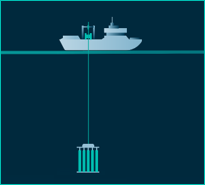
CTD / Rosette
Grabbing
Core Sampling
ROV Operations
Plankton Sampling
Towing AHC

Towed Cameras
Other Towed Bodies
Sidescan Sonars
ROTV
Plankton Sampling
Why Constant Tension Isn't Enough for Scientific Subsea Operations
Constant tension (CT) stabilises equipment through winch tension alone. It works reasonably well for heavy loads, but scientific equipment is typically lightweight and streamlined, so CT has limited stabilising effect once the weather deteriorates. Active Heave Compensation solves this differently: instead of relying on tension, AHC measures the vessel's motion directly and moves the winch to cancel it out, so the equipment's weight and shape become largely irrelevant to how stable it stays.
| Constant Tension | Active Heave Compensation | |
|---|---|---|
| Mechanism | Maintains winch line tension | Cancels vessel motion directly |
| Best suited for | Heavy loads | Any weight, especially light or streamlined equipment |
| Effect in rough weather | Limited on light equipment | Consistent regardless of conditions |
| Typical use | Legacy scientific winches | CTD, towed sensors, ROV, coring |
AHC technology has mainly been available on large offshore winches, but Scantrol's solutions make it economically feasible to add AHC to small and medium research vessel winches.
What Active Heave Compensation Does for Your Research Data
Whether you are towing a camera or a towfish, or deploying scientific equipment under the vessel, Active Heave Compensation can ensure high data quality in all weather conditions.
mTrack Capabilities for Scientific Equipment
Active Heave Compensation
Keeps your CTD, core sampler, grab, or towed sensor stable relative to the seabed, independent of vessel motion.

Auto Depth
Deploys equipment smoothly and precisely to a set depth or depth interval. Built for depth-stratified sampling programs.

Follow Seabed
Maintains a constant distance to the seabed when towing a camera, towfish, or sidescan sonar.

mTrack AHC Case Studies
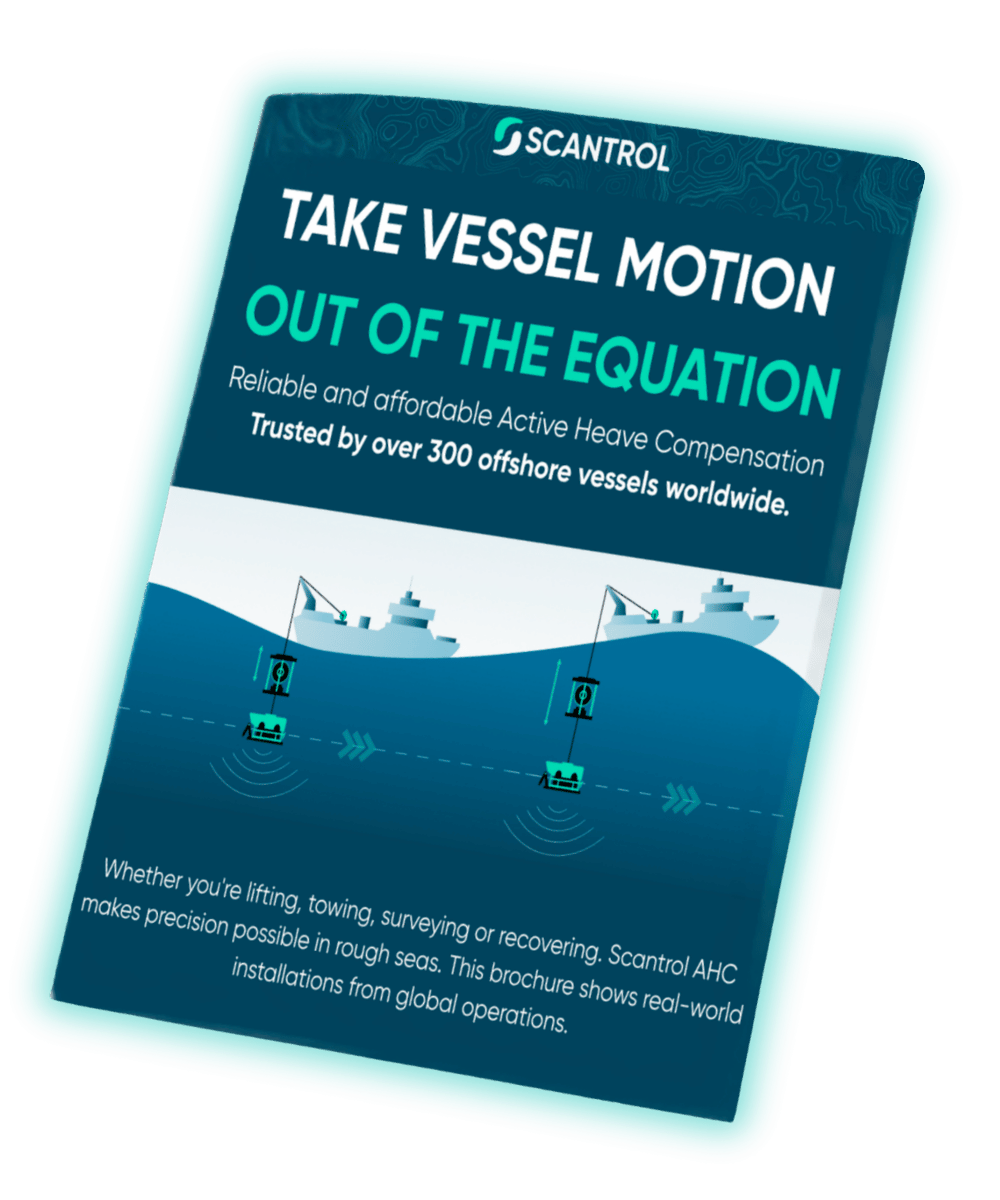
What Happens When Vessel Motion Is No Longer the Limiting Factor
Explore case studies from operators using mTrack AHC in rough sea states, deep water and time-critical operations. Each one shows the specific application, the integration approach and the outcome reported by the operator.
Can You Retrofit AHC to an Existing Research Vessel Winch?
Many oceanographic and scientific winches already in service are suitable for AHC retrofit. Reusing the existing winch represents a major cost reduction compared to buying a new winch, and results in a reduced carbon footprint.
The winch's maximum line speed determines how much vessel motion it can compensate for. A winch with a maximum line speed of 50–80 m/min will typically compensate for 3–4 m of vessel motion, sufficient for most scientific and research operations.
→ Get Free AHC Capacity Analysis
→ How to retrofit mTrack to existing winches

Frequently Asked Questions
-
Active heave compensation measures vessel motion and controls the winch so that heave is filtered out, keeping scientific equipment in a stable position in the water regardless of its weight or shape. This maintains data quality for research operations conducted in variable sea conditions.
-
Constant tension is designed to stabilize equipment through winch tension alone. Because scientific equipment is typically lightweight and streamlined, constant tension has limited stabilizing effect in bad weather. Active heave compensation directly counteracts vessel motion instead, providing stability independent of the equipment's weight or shape.
-
AHC is used with CTD/Rosette samplers, grabbing equipment, core sampling tools, ROV operations, and plankton sampling gear, as well as towed equipment such as cameras, sidescan sonars, and ROTVs. Each application uses a pre-configured mTrack setup for its specific deployment method.
-
Yes. mTrack's Follow Seabed function maintains a constant distance between towed equipment, such as a camera or towfish, and the seabed, adjusting automatically as vessel motion and seabed depth change during the tow.
-
Yes. Many existing winches on research vessels are suitable for AHC operation. Reusing the existing winch reduces cost compared to purchasing new equipment and avoids the added carbon footprint of a full winch replacement.
-
The underlying technology is the same. Active heave compensation cancels vessel motion regardless of the equipment involved, but scientific and research winches are typically smaller and lighter-duty than offshore cranes. mTrack is pre-configured for both, and capacity is assessed individually per winch rather than by a single tonnage rating.
-
Yes. mTrack was specifically designed to make AHC economically affordable for small and medium winches, not just large offshore installations. It suits survey vessels, USVs, and other smaller research platforms as well as larger multipurpose vessels.
Have questions or would you like to discuss your project?
If you have any questions about AHC, your application, or next steps, you are welcome to reach out directly.

Suzy Zhu
International Sales Manager
Email: suzy@scantrol.com
Phone: +47 465 20 370
Jan Kjærstad
CEO
Email: jan.kjarstad@scantrol.com
Phone: +47 911 59 434

Henry Boddington,
International Sales Manager
Email: henry@scantrol.com
Phone: +47 901 57 044
We are happy to review your setup, answer technical questions, or schedule a meeting