
Active Heave Compensation for Boulder Clearance and Salvage
When you work close to the seabed or on a shipwreck, vessel motion is what limits control. Scantrol AHC removes it from the equation.

Active heave compensation (AHC) for boulder clearance and salvage keeps a grab, winch, or A-frame stable relative to the seabed or a wreck site, removing vessel motion from the equation. mTrack, Scantrol's AHC controller with integrated motion reference unit (MRU), adds this stabilisation to an existing winch or A-frame without replacing the mechanical hardware.
For operators, this means the grab or recovery tool holds its position steady when working close to the seabed or a wreck, even in swell, reducing the risk of shock loads on fragile structures and contact damage near subsea infrastructure.
mTrack AHC Controller
Off-the-shelf AHC controller with integrated MRU - no separate sensor required
Pre-defined apps for winch, crane, LARS, and cylinder - no custom programming needed
Auto Calibration and Dynatest included - commission at dockside, no sea trials
Includes all the tools you need for easy installation - no need for expensive experts
Manual control retained - operators keep the same controls, AHC runs in the background
The off-the-shelf AHC controller that brings active heave compensation to grabs, A-frames, and salvage winches

Why Vessel Motion Is the Limiting Factor
Boulder clearance and salvage operations put a winch or grab in some of the most motion-sensitive positions in subsea work.
Working near the seabed or a wreck
A grab picking up individual boulders, or a recovery tool working over a wreck, operates in a constrained space. Vessel heave transmitted through the winch line makes it difficult to hold position accurately, risking contact damage to the load, the seabed, or nearby infrastructure.
Unpredictable load behavior
Loads on a salvage site can shift unexpectedly as they are freed from silt, debris, or wreckage. Wreck structures are often fragile after years underwater. Uncompensated vessel motion adds dynamic shock loading on top of an already unpredictable load.
A shrinking weather window
Without AHC, boulder clearance and salvage work is typically limited to calmer sea states, since manual winch operation becomes imprecise once vessel motion increases. That limits workable days on a project with a fixed budget and timeline.
This video shows mTrack AHC in an ROV operation. The same principle applies to boulder clearance and salvage: Scantrol AHC removes vessel motion from the equation.
Scantrol News | 12/20/17
Record Express AHC Delivery for AHC Salvage operation
Scantrol recently mobilized an Active Heave Compensation (AHC) Upgrade system in less than 4 hours for Aberdeenshire-based solutions provider Aleron Subsea. The system will be used in a profiled Salvage operation to find Britain’s lost treasures from the World Wars.

–We were able to ship off a complete AHC system in only 3 hours and 26 minutes due to a highly standardized control system and good communication with the customer.
“The system was already configured before shipment. In today’s subsea market we need to be able to turn around quickly when a customer needs an AHC system to get the job done. Upgrading an existing system is a cost-efficient and time-saving solution when working on a tight timeline,” explains Rolf Krogh Hjelmeland, Business Development Manager for Scantrol AHC.
“Our AUXROV system was working in some of the harshest conditions in a wreck at 120 meters in more than 4 meters of swells. The AUXROV was in the water for over 90 hours at a time with all systems working perfectly. The winch was in active heave all the time and Scantrol system operated faultlessly” explains Chief Executive Operator (CEO) at Aleron Subsea, Mike Bisset.
AHC for Treasure Hunting
Aleron Subsea was appointed by James Fisher Marine and Britannia Gold Ltd (BGL) to utilize their AUXROV system to assist their highly profiled Salvage operations targeting wrecks that sank during Worlds Wars 1 and 2. This is the first of a series of planned operations by BGL.
Working with a tight timeline to mobilize the equipment Aleron Subsea contacted Scantrol, with whom they have done AHC retrofit previously.
–The last AHC upgrade we did together was successful and we are pleased to work with Scantrol again on this project.
We gave them a few days’ notices to supply an active heave system for our 30 Ton winch which worked absolutely perfectly, reveals Bisset.

Successful result: Mike Bisset (CEO) reveals that the customer is pleased with the system in operation.
Short Delivery Time with Standardized Solutions
The order was received on Monday at lunchtime. The Scantrol team quickly turned around to meet the tight timeline of one-day delivery time. Martin Nybø, Service Engineer at Scantrol, and his colleague, Johannes Sletteskog, managed to get the system assembled and tested before the end of the day and shipped off to Aberdeen on the same night. When Martin arrived the test site Tuesday morning together with the control system, the winch had only just been rotated by means of a hydraulic lever.
Scantrol took advice from their associate UK Company, Dynamic Integrating Ltd, who vetted the hydraulic system for AHC compatibility. This reassurance took no time at all and Scantrol were able to give Aleron a quick and confident solution.
–By Tuesday evening we had the whole control system up and running, and were able to control the winch from it. Wednesday at lunchtime the system was fully commissioned and we were running dynatests showing promising compensation levels. In less than two days we had successfully integrated the control system with the winch and had it ready for shipping. This was achieved due to our standardized AHC solutions for different applications and to a dedicated and efficient team of engineers working on this project, explains Martin.

Express delivery: Johannes Sletteskog and Martin Nybø turned around quickly Monday morning to get the AHC system to Aberdeen on the same day.
Efficient Operation with AHC
The AUXROV was configured with a 30 Ton winch and 30 Ton A-frame in order to provide the client with valuable information on the contents of the grabbed materials in real time. It was able to enter several constrained hard to reach areas of the site assisting in the overall efficiency of the operation.
The AHC functionality gives the operator the possibility to stabilize the load, but still use the familiar control system for manual handling of the winch.
Having AHC functionality on the AUXROV system saves the operation from downtime due to bad weather conditions. This means that the vessel will be able to continue the operation in harsh sea and the operator can perform safe and reliable operations.

AHC Upgrade: Adding AHC to the system allows the vessel to increase operational time at sea.
mTrack AHC Case Studies
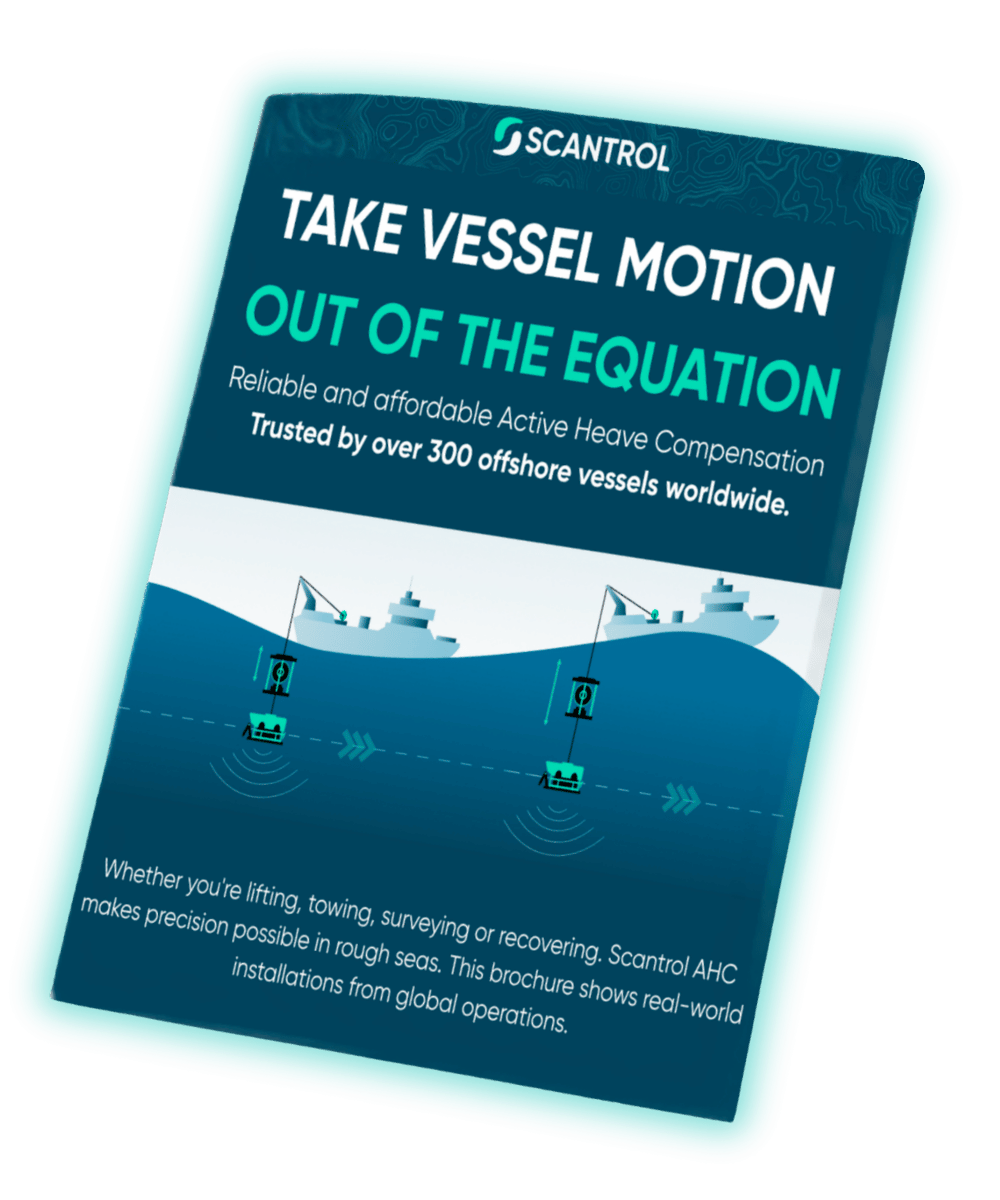
What Happens When Vessel Motion Is No Longer the Limiting Factor
Explore case studies from operators using mTrack AHC in rough sea states, deep water and time-critical operations. Each one shows the specific application, the integration approach and the outcome reported by the operator.
Can My Existing Winch Be Retrofitted?
Most existing winches, A-frames, and grabs used in boulder clearance and salvage work can be retrofitted with mTrack without replacing the mechanical hardware. As a general guide, a winch with a maximum line speed of 50–80 m/min will typically compensate for 3–4 m of vessel motion, sufficient for most boulder clearance and salvage operations.
Reusing existing mechanical hardware reduces cost compared to buying a new winch and lowers the carbon footprint of the upgrade.
→ Get Free AHC Capacity Analysis
→ How to retrofit mTrack to existing winches

Frequently Asked Questions
-
Active heave compensation stabilizes a grab, winch, or A-frame during boulder clearance and salvage work by counteracting vessel motion in real time. This keeps the load steady when working close to the seabed or on a wreck, maintaining control and subsea visibility regardless of wave conditions.
-
Yes. mTrack connects to an existing winch or A-frame control system without replacing the mechanical hardware. Reusing existing equipment reduces cost compared to purchasing a new winch and avoids the carbon footprint of new equipment.
-
AHC keeps the grab or recovery equipment stable relative to the seabed, improving control when working in constrained or hard-to-reach areas of a wreck site. This reduces downtime caused by bad weather and allows operations to continue in sea states that would otherwise halt work.
-
No. AHC adds stabilization to the load while the winch retains its existing control system for manual handling. Operators use the same familiar controls, with active heave compensation running in the background during subsea placement and recovery.
-
Yes. AHC gives the operator the option to stabilize the load automatically, while still using the familiar control system for manual handling when needed. This flexibility allows operators to switch between manual and compensated control depending on the task.
Have questions or would you like to discuss your project?
If you have any questions about AHC, your application, or next steps, you are welcome to reach out directly.

Suzy Zhu
International Sales Manager
Email: suzy@scantrol.com
Phone: +47 465 20 370
Jan Kjærstad
CEO
Email: jan.kjarstad@scantrol.com
Phone: +47 911 59 434

Henry Boddington,
International Sales Manager
Email: henry@scantrol.com
Phone: +47 901 57 044
We are happy to review your setup, answer technical questions, or schedule a meeting