
Active Heave Compensation for Drilling & Coring
Add AHC to your existing PHC system and avoid problems when drilling or coring in soft or fractured ground.
Active heave compensation (AHC) for drilling and coring rigs adds active correction on top of an existing passive heave compensation (PHC) system, increasing total motion compensation up to 95%. One or two active cylinders run in parallel with the passive cylinders, controlled by the mTrack AHC controller and its integrated motion sensor (MRU). This removes the friction and volume-variation errors inherent in PHC alone, so the drill string stays stable even in soft or fractured ground.
For rig operators, this means constant weight on bit (WOB), smoother torque delivery, fewer bit lift-off events, and fewer stopped runs from core jamming. Because AHC runs alongside the PHC system rather than replacing it, the retrofit does not change how the PHC operates day-to-day, and it can be isolated whenever active compensation is not required.

mTrack AHC Controller
The off-the-shelf AHC controller that adds active heave compensation to your existing PHC system
Off-the-shelf AHC controller with integrated MRU - no separate sensor required
Pre-defined app for drilling/coring cylinders - no custom programming needed
Auto Calibration and Dynatest included - commission at dockside, no sea trials
Includes all the tools you need for easy installation - no need for expensive experts

Scantrol AHC offers the following benefits for drilling and coring operations:
Increase vessel motion compensation up to 95%
Stabilize drill string motion
Keep constant WOB
Smooth torque
Reduce bit lift-off
Better core quality
Improve drilling ROP
Less core jamming
Why PHC Alone Isn't Enough
A passive heave compensator (PHC) is a reactive device. It uses stored energy, typically an air cushion, to counteract vessel heave, but it has to overcome internal seal friction every time the ship moves. That friction shows up as fluctuating weight on bit and residual drill string motion that PHC alone cannot fully remove.
AHC adds an actively controlled hydraulic cylinder that counteracts this residual friction and motion in real time. Combining AHC with an existing PHC system is what meaningfully reduces bit lift-off and WOB variation compared to PHC alone, particularly in soft or fractured formations where hole stability already depends on consistent bit contact.
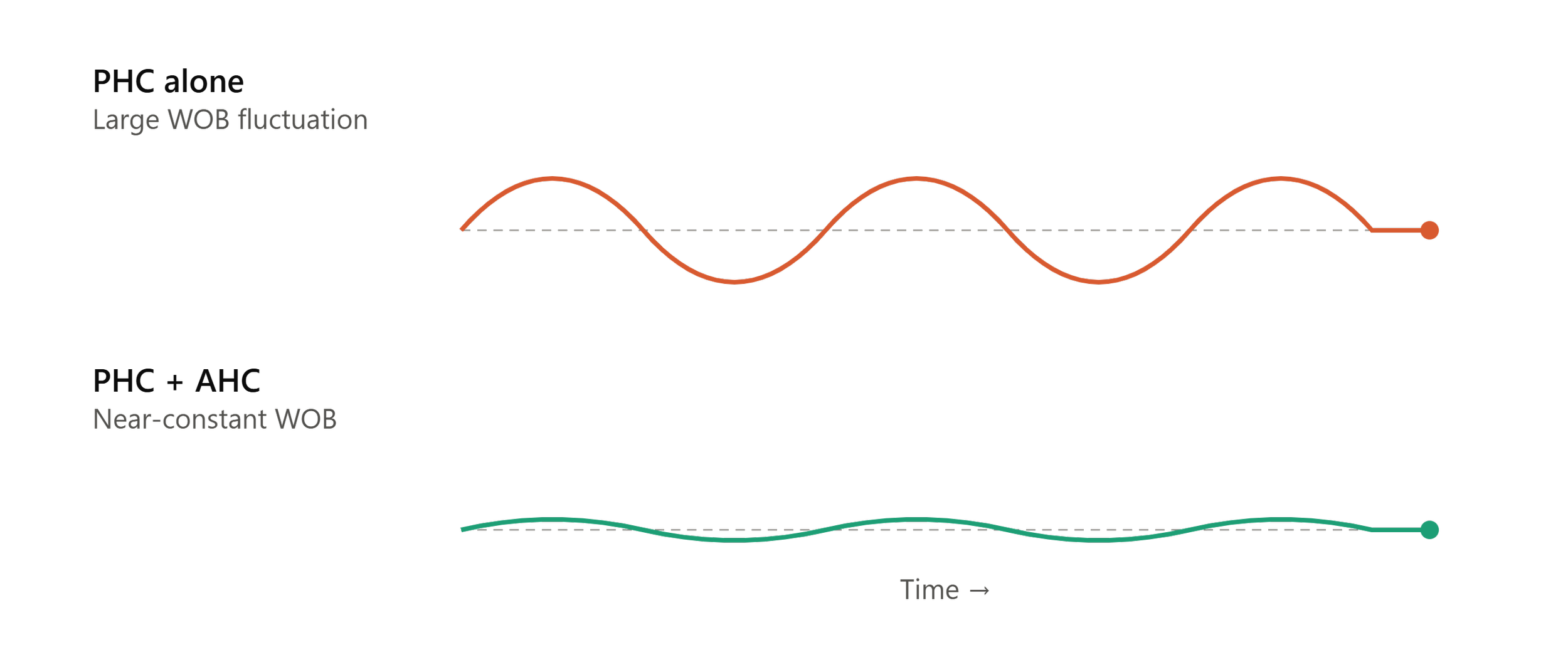
Combining AHC with an existing PHC system reduces weight-on-bit fluctuation from large swings to near-constant levels.
How to add Active Heave Compensation (AHC) to your Passive Heave Compensation System (PHC)
1. Install one or two active cylinders in parallel with the passive cylinders. The stroke length must be identical to the passive cylinders, but the cylinder volume will be significantly smaller. A stroke sensor is required if it is not already installed as part of the PHC system.
2. Install hydraulic powerpack and cylinder control valves.
3. Install mTrack AHC controller and connect it to cylinder valves and cylinder position sensor.
4. Run Auto Calibration and Dynatest to test and verify AHC performance.
No sea trials required.
No hidden cost.

There will be no change to the PHC system, and its basic operation will remain the same.
Scantrol AHC can be turned off and completely isolated from PHC when in situations when AHC is not required.
Is My Existing Drilling Rig Suitable for AHC Retrofit?
Most rigs already running a passive heave compensation (PHC) system are good candidates for an AHC retrofit. Because the active cylinders run in parallel with your existing passive cylinders using the same stroke length, the retrofit reuses your current mechanical hardware rather than replacing it, reducing both cost and installation time compared to a full system replacement. The same mTrack controller is also used for OEM integration on new equipment, so the same retrofit logic applies whether you are upgrading an existing rig or specifying AHC for a new build.
Use the free AHC capacity check to evaluate your setup, or see how mTrack retrofits work on other equipment types. If you need external help designing or upgrading the hydraulic drive itself, our network of partners can assist.
→ Get Free AHC Capacity Analysis
→ How to retrofit mTrack to existing winches

AHC Toolbox
Scantrol AHC Toolbox has tools that can help you in the design phase and verify the design of your AHC system.

mTrack AHC Case Studies
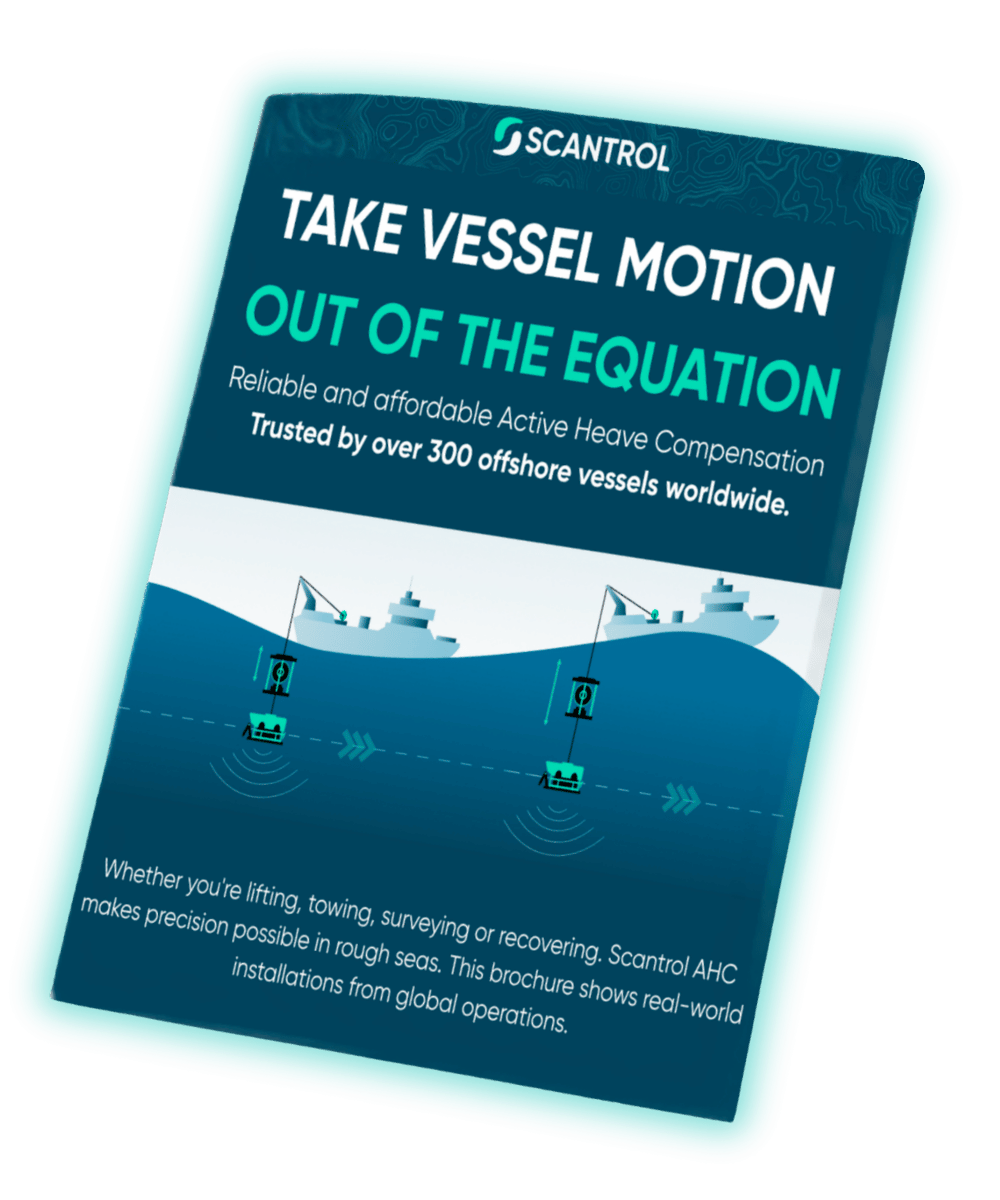
What Happens When Vessel Motion Is No Longer the Limiting Factor
Explore case studies from operators using mTrack AHC in rough sea states, deep water and time-critical operations. Each one shows the specific application, the integration approach and the outcome reported by the operator.
Frequently Asked Questions
-
Active heave compensation stabilizes drill string motion by counteracting vessel heave in real time. This maintains constant weight on bit (WOB), smooths torque delivery, improves rate of penetration, reduces core jamming, and improves overall core quality compared to passive compensation alone.
-
Yes. One or two active cylinders are installed in parallel with the existing passive cylinders, using the same stroke length. Combined with a hydraulic powerpack, control valves, and the mTrack AHC controller, this adds active compensation of up to 95% without replacing the PHC system.
-
No. The PHC system continues to operate exactly as before. The AHC addition can be turned off and fully isolated from the PHC system whenever active compensation is not required for the operation.
-
One or two active cylinders installed parallel to the existing passive cylinders, a hydraulic powerpack with cylinder control valves, a stroke sensor if not already present, and the mTrack AHC controller connected to the cylinder valves and position sensor.
-
No. Auto Calibration and Dynatest verify AHC performance at the factory or dockside before the system goes offshore. This confirms drilling and coring performance without the cost or scheduling delay of sea trials.
-
Bit lift-off happens when vessel heave lifts the drill string faster than the compensation system can respond, momentarily lifting the bit off the borehole bottom. It disrupts core quality and can damage the bit. Active heave compensation reduces bit lift-off by correcting the residual motion that a passive system alone cannot remove.
Have questions or would you like to discuss your project?
If you have any questions about AHC, your application, or next steps, you are welcome to reach out directly.

Suzy Zhu
International Sales Manager
Email: suzy@scantrol.com
Phone: +47 465 20 370

Jan Kjærstad
CEO
Email: jan.kjarstad@scantrol.com
Phone: +47 911 59 434

Henry Boddington,
International Sales Manager
Email: henry@scantrol.com
Phone: +47 901 57 044
We are happy to review your setup, answer technical questions, or schedule a meeting